A Software Engineer's AC Story Shows Why HVAC Diagnostics Are Debugging, Not Guesswork
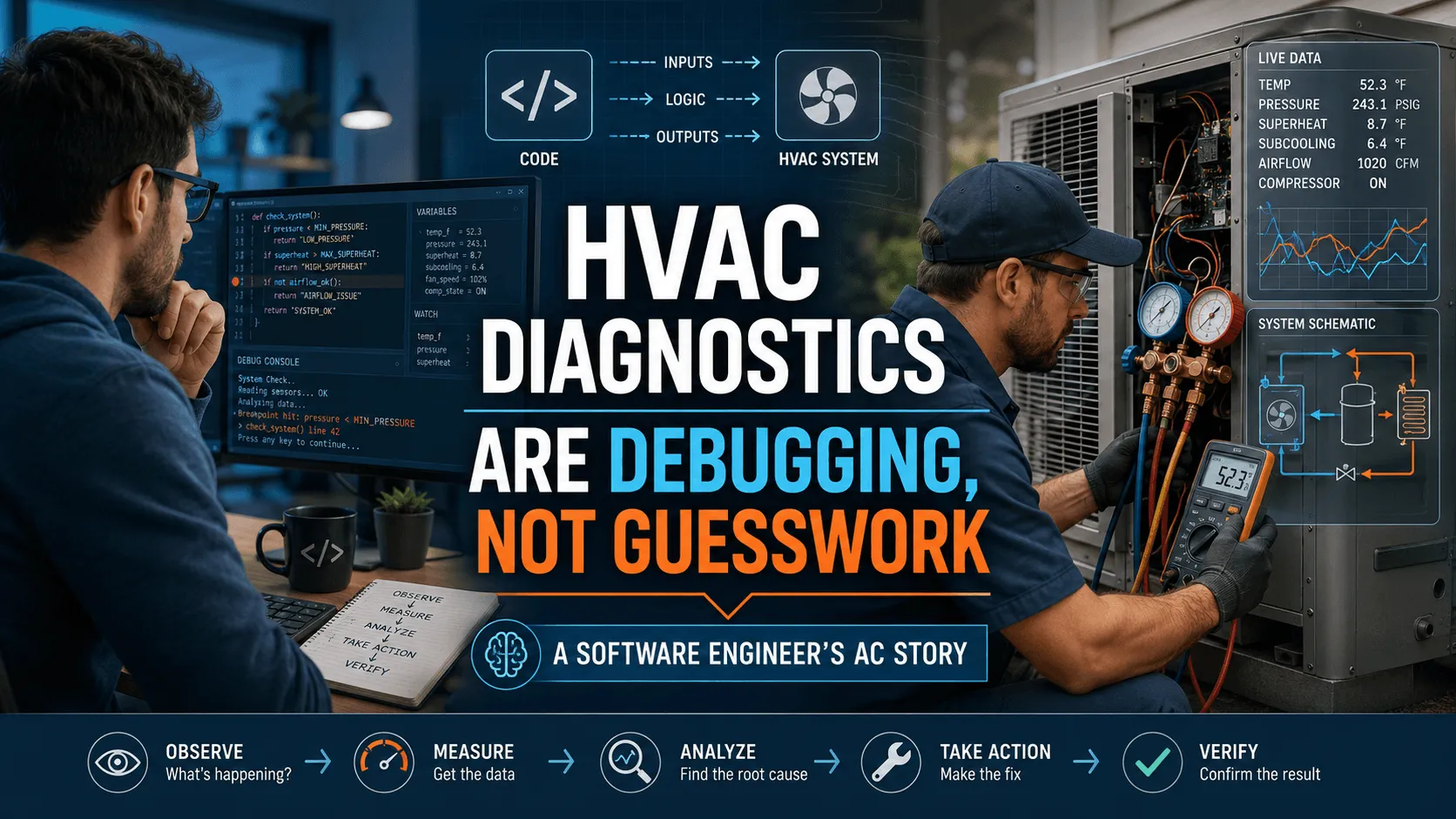
A software engineer's broken AC story makes a useful point for HVAC diagnostics: measure first, explain the result, and rule out bad assumptions before replacing parts.
AI Summary
Uses one software engineer's broken AC story to explain why HVAC diagnostics and software debugging both depend on disciplined reasoning instead of confident guessing. The article argues that technicians should show what they measured, explain what the result means, and use structured workflows like ACLogics to narrow the problem before recommending a repair.
A recent LinkedIn post from software engineer Daniel Kats used a broken AC story to make a point about debugging. You can read the full post on LinkedIn.
The HVAC part is what caught our attention, because the mistake pattern is familiar.
Something breaks. Everyone wants the answer fast. The first explanation sounds reasonable. Then another explanation sounds reasonable too.
That is where bad repairs start.
In software, a senior engineer does not want a guess dressed up as confidence. They want to know what was observed, what was tested, what changed, and what the evidence ruled out.
HVAC is not different enough to ignore that lesson.
A confident answer is not the same as a diagnosis
Picture a no-cooling call where one technician says the evaporator coil probably has a leak. Another says the issue is probably in the refrigerant lines. A third says the compressor is the real problem.
Any one of those could be true.
That is the uncomfortable part. A bad diagnosis does not always sound ridiculous. Sometimes it sounds experienced. Sometimes it sounds like something the technician has seen ten times before.
But the customer, the service manager, and the next technician all need more than “usually it is this.”
They need the truth underneath the answer:
- What did you measure?
- What should the measurement have been?
- What does the result prove?
- What does it rule out?
- Why is this the next thing to check?
That is the difference between troubleshooting and guessing.
Symptoms are clues, not verdicts
Low refrigerant pressure is a clue. Oil near a line set is a clue. A compressor that will not start is a clue. A fault code is a clue.
None of those clues is the whole case by itself.
This is where HVAC diagnostics starts to look a lot like debugging code. A software bug can show up as a slow page, a failed payment, or a timeout in one service. The symptom may be visible in one place while the cause lives somewhere else.
HVAC does the same thing. Poor airflow can make the refrigerant side look strange. A weak capacitor can look like a compressor problem until the electrical tests are done. A refrigerant issue can be real and still be a symptom of a different failure.
The job is not to name the first part that might be involved.
The job is to narrow the problem until the explanation survives the measurements.
The better technician explains the why
The technician you want on your team does not just say, “It is probably the compressor.”
They say something closer to this:
“Here is the voltage I measured. Here is the amp draw. Here is what the capacitor tested at. Here is why that rules out the control side. Here is why I am moving to the compressor circuit next.”
That kind of explanation does two things.
First, it protects the customer from a parts-changing repair. Second, it protects the company from a callback that could have been avoided with one more check.
It also makes training easier. A junior technician can learn from a clear diagnostic path. They cannot learn much from a shrug and a hunch.
Generic AI can make the same mistake
This is also where AI tools can go wrong.
If you ask a generic AI tool for a diagnosis and give it a thin problem description, it may do what the first two technicians did. It may give the most common answer too early.
That answer can sound polished. It can even be plausible.
But plausible is not enough in the field. A technician still needs readings, context, sequence, and judgment. The tool should be pushing for better inputs, not pretending a short symptom description is a full diagnosis.
That is why ACLogics is built around symptoms, readings, and next checks instead of just a blank chat box. The point is not to replace the technician. The point is to help the technician slow down the guess, capture the evidence, and move through the problem in a cleaner order.
The repair still belongs to the person in front of the equipment.
Debugging is just disciplined narrowing
The best software engineers are not the ones who guess the fastest. They are the ones who know how to reduce uncertainty.
Good HVAC technicians do the same thing.
They test voltage before condemning a motor. They check airflow before chasing refrigerant. They compare pressure, temperature, superheat, subcooling, amp draw, and system behavior before deciding what the customer needs to buy.
That discipline matters because every wrong assumption has a cost. It can mean a wasted part, a second truck roll, a frustrated customer, or a senior technician pulled away from another job to clean up the first diagnosis.
So yes, one software engineer’s AC story ended up sounding a lot like an HVAC diagnostic lesson.
The useful part is not the coding analogy. The useful part is the standard behind it.
Do not be the person who says, “I guess it is this.”
Be the person who can say, “This is what I measured. This is what it means. This is why I am checking this next.”
That is the work.